


TMNT: Shredder's Revenge
4.6641.00 Reviews
App Specs
- Version
- 1.2.20
- Updated On
- License
- Free
- Downloads
- 1,000,000+
- Developer
- Playdigious
- Categories
- Action
- Platform
- Android
Screenshots
 Analysis by AppCompare
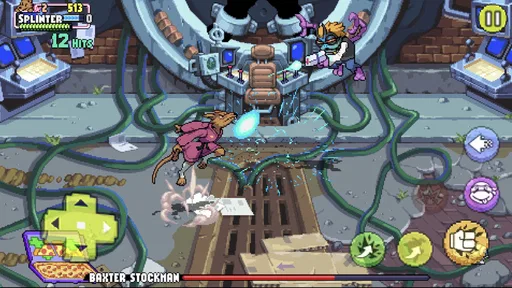
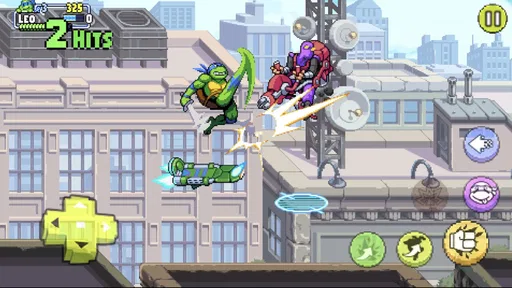
I went into TMNT: Shredder's Revenge expecting a straightforward licensed action game, but I found something more focused: a compact beat ’em up that understands why this style remains enjoyable. It puts the Teenage Mutant Ninja Turtles in a side-scrolling fight through colorful stages, with quick attacks, crowd control, and a strong emphasis on keeping the action moving. My main takeaway is simple: this is an excellent choice when I want a lively arcade-style session on my phone, although it is less convincing for anyone looking for a deep, endlessly changing action game.
Playdigious handles this mobile version, and the result feels designed for short bursts rather than long, demanding campaigns. The game is free to start, carries an Everyone 10+ content rating, and belongs firmly in the action category. Its store presence is already substantial, with more than a million installs and a 4.6 average from roughly thirteen thousand ratings. Those numbers do not replace personal experience, but they match what I noticed: the game is easy to understand within minutes, immediately recognizable to fans, and polished enough to make repeated runs appealing.
Why the fighting works so well on a phone
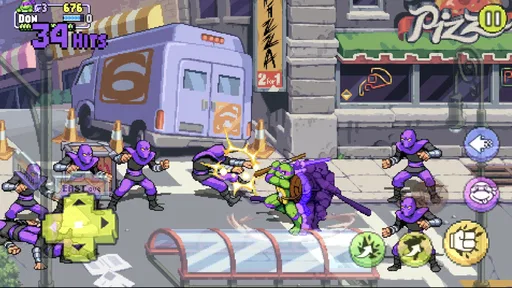
The best part of this game is its rhythm. I move through a stage, meet a group of enemies, read their positions, attack, dodge or reposition, and then continue. That loop sounds basic, but the timing gives it energy. Button presses feel most satisfying when I stop treating every encounter as a button-mashing contest and instead use movement to gather enemies, avoid being surrounded, and choose the right moment to strike.
The turtles do not feel interchangeable once I spend time with them. Each one encourages a slightly different approach, whether I prefer direct damage, safer spacing, or a more mobile style. I found that switching characters helped keep familiar stages from becoming completely routine. It also made cooperative play more appealing, because choosing a different turtle can change how I contribute to a group rather than simply changing the color of my character.
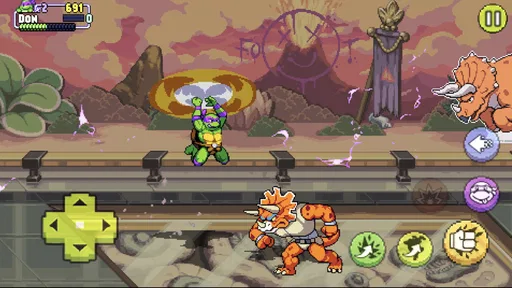
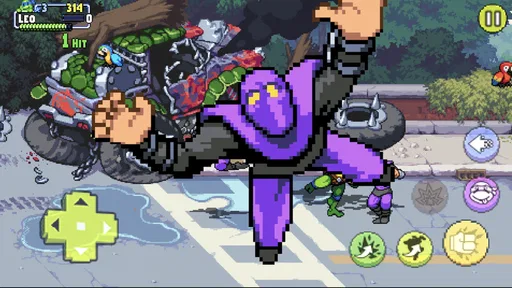
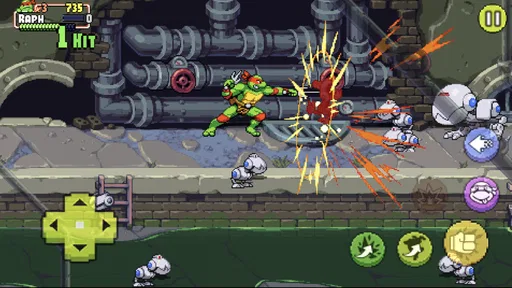
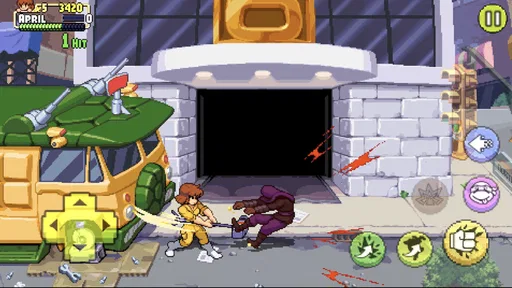
The important strength is the clarity of the combat. Enemies are readable, attacks have a satisfying arcade snap, and the screen generally communicates what deserves my attention. That matters on a touchscreen, where clutter and imprecise controls can quickly turn a simple fight into frustration. I rarely felt lost about why I had taken damage; usually, I had either stood in the wrong place or attacked without considering the surrounding crowd.
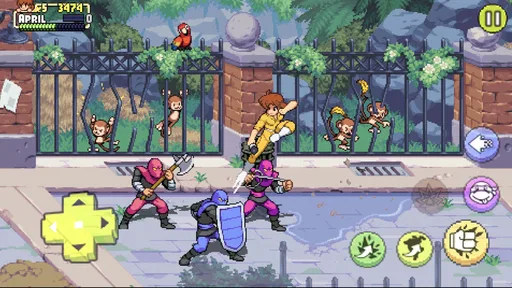
The stages also do more than provide a flat corridor. They move through recognizable urban environments and keep encounters visually varied enough that progress does not feel like walking through identical rooms. Environmental details give the journey personality, while the steady arrival of new threats prevents the basic attack pattern from becoming completely automatic. I especially liked the moments when the game briefly changes the pace with a larger encounter or a more demanding group of opponents.
That structure makes the game particularly comfortable for a quick evening session. I can play a stage when I have a little free time, enjoy a clear beginning and end, and put the phone away without feeling that I have interrupted a complicated long-term plan. For a commute, a short break, or a relaxed session after work, that accessibility is a real advantage over action games that require a large time commitment before they become enjoyable.
Worth Reading Before You Choose

EA SPORTS FC Mobile 26 Is a Bigger Football Game, but It Takes Time

Flipboard Shows What News Apps Must Do Beyond the Feed

Switching to Android Auto Means Rethinking Your Driving Routine

Google Calendar Makes a Crowded Week Easier to Manage

Ludo King Makes the Most of the Minutes Between Plans

Baby Panda World Brings Quick Play to Modern Phones, but Its Game Library Feels Busy
Touch controls reward a little preparation
My first few minutes were less comfortable than the rest of the experience because touchscreen action games always demand adjustment. The virtual buttons occupy part of the display, and the most natural position for my hands depends on how I hold the phone. I recommend spending time in a safe early section learning the distance between attack, jump, special actions, and movement instead of immediately blaming the game when a combination feels awkward.
A useful habit is to avoid pressing every action at once. I had better results when I used movement first, created a little space, and then committed to an attack. This is more important during crowded encounters, where a mistimed jump or unnecessary special move can leave me exposed. The game is approachable, but it still rewards the same basic discipline as a traditional arcade beat ’em up: control the crowd rather than chasing one enemy blindly.
Playing with the phone held securely also makes a difference. Because the action can fill the screen with enemies and effects, accidental touches are more likely when my grip is loose or when I try to reach across the display. I found the experience more reliable when I used both hands and kept my thumbs close to their usual controls. That is a small practical point, but it can decide whether a session feels responsive or irritating.
Players who dislike virtual controls should keep their expectations realistic. A mobile layout cannot reproduce the exact feel of a physical arcade stick or a controller. The game does a good job of translating the basics, but precision is still influenced by screen size, hand position, and the phone itself. On a larger display, the buttons felt easier to manage; on a smaller one, the action demanded more concentration.
Progression is useful, but the arcade core remains central
The game gives me reasons to return beyond simply reaching the end of a stage. Replaying sections can improve my familiarity with enemy patterns and help me become more efficient, while the character variety adds a modest layer of experimentation. I enjoyed testing a different turtle after becoming comfortable with my first choice, because it exposed weaknesses in habits I had not noticed before.
Still, this is not an action role-playing game built around elaborate equipment, huge character builds, or constant statistical optimization. That is both a strength and a limitation. I never felt buried under menus, but I also could not rely on a deep progression system to make every replay feel dramatically different. The lasting appeal comes mainly from improving my play, enjoying the cast, and sharing the action, not from collecting an endless supply of upgrades.
This distinction helps explain who will enjoy it most. If I want a clean arcade experience with modern presentation, the restrained progression feels appropriate. If I expect a mobile game to provide a constantly expanding set of systems, it may seem light after the initial excitement. The game is at its best when I judge it as a polished beat ’em up rather than as a substitute for a large-scale action role-playing adventure.
The free entry point makes it easy to try, but the presence of in-app purchases means I still pay attention to how I approach the game. Individual purchases range from forty-nine cents to eight dollars and ninety-nine cents. I would advise deciding in advance whether I am simply sampling the experience or whether I am comfortable spending money on optional additions. That small boundary helps preserve the relaxed nature of the game instead of turning every return visit into a shopping decision.
What happens when the novelty wears off
The main weakness is repetition. Beat ’em ups naturally depend on repeated encounters, and even with different characters and changing scenery, the basic pattern remains familiar: advance, fight a group, avoid hazards, defeat a tougher opponent, and continue. I enjoyed that loop for several sessions, but I could also see the structure becoming predictable for players who need constant mechanical surprises.
Enemy variety helps, but it does not completely solve the issue. Once I understand the safest response to a particular threat, meeting that enemy again becomes more about execution than discovery. That is satisfying when I am chasing a cleaner run, but less exciting when I simply want the game to surprise me. Someone who prefers roguelikes, competitive action games, or large exploration worlds may find the fixed beat ’em up structure too narrow.
The difficulty curve can also feel uneven depending on how carefully I play. Early fights teach the basics in a friendly way, but later groups can punish careless positioning quickly. I appreciated that the game does not remove all challenge, yet a player arriving only for a casual button-mashing session may be surprised by how much attention the tougher encounters require. The answer is not complicated: slow down, watch the crowd, and use the available attacks with purpose.
Another limitation is that the game’s strongest appeal depends on enjoying the Teenage Mutant Ninja Turtles setting. I do not need to be a dedicated fan to understand the action, but the characters, tone, and presentation provide much of its charm. Without that connection, the familiar beat ’em up framework has to carry the entire experience. It does so competently, but the licensed personality is a major part of why this version stands out from less distinctive alternatives.
How it compares with other mobile action choices
Compared with an endless runner, this offers more deliberate control and more meaningful combat decisions, but it does not provide the same effortless one-handed flow. Compared with a competitive arena game, it is calmer and more self-contained, with less pressure from other players and less dependence on a constantly changing online environment. Compared with a large action role-playing game, it is easier to pick up and far less demanding, but it also offers less exploration and long-term customization.
I would choose this over a generic mobile brawler when I want a clear sense of place and a cast with personality. I would choose a different option when my priority is deep character building, open-ended exploration, or a huge amount of replay variation. The comparison is not about which genre is universally better. It is about whether I want a focused arcade session or a game that asks me to build a longer routine around it.
The mobile format also changes the best way to play. On a console, I might settle in for a longer campaign with a controller. On a phone, I naturally treat each stage as a self-contained activity. That makes the game more useful in ordinary daily situations: I can play after finishing a small task, stop before another commitment, and return later without needing to remember a complicated set of objectives. The straightforward structure is a better fit for those moments than a game that punishes interruptions.
Who should install it, and who should skip it
I recommend it to fans of classic side-scrolling action, players who enjoy recognizable characters, and anyone who wants a game that becomes fun quickly rather than requiring a long tutorial. It is also a good pick for friends or family members who want to share a colorful action experience without first learning a complicated control scheme. The age rating makes it accessible to a broad audience, while the combat still offers enough timing and positioning to keep experienced players engaged for a while.
I would be more cautious recommending it to someone who dislikes touchscreen controls, expects a large open world, or needs a constant stream of new systems to stay interested. Players who prefer quiet puzzle games may also find the continuous fighting tiring, while competitive players may miss the tension of facing human opponents. If the appeal of an action game comes mainly from deep builds, ranked matches, or procedural unpredictability, this is probably not the best fit.
For a practical example, imagine having twenty minutes before leaving home. I can start a run, focus on one stage, and stop at a natural point without committing to a long session. If I have more time on the weekend, I can replay with another turtle and concentrate on cleaner movement rather than simply rushing forward. That flexibility is one of the game’s most valuable qualities, and it is more useful to me than a long list of features I would rarely touch.
New players should resist the temptation to use special attacks whenever they become available. Saving them for crowded situations or dangerous enemies makes later sections more manageable. I also recommend learning one character thoroughly before switching among the full cast. That gives me a reliable baseline for judging the others and prevents the controls from feeling unfamiliar every time the action becomes busy.
The current version is 1.2.20, and the game was released on April 15, 2025. It supports devices running Android 9 or later. Those details matter when deciding whether an older phone is suitable, especially because fast action is less enjoyable when the device struggles with input or display responsiveness. I would check the operating system before planning to play regularly, then test the controls during the opening section before considering any purchase.
My final recommendation
After spending time with it, I see TMNT: Shredder's Revenge as a confident mobile beat ’em up with a clear identity. Its strongest qualities are responsive-feeling combat, approachable structure, character variety, and the ability to turn a short break into a satisfying arcade session. It does not try to become a massive role-playing game, and I think that restraint works in its favor.
Its drawbacks are equally clear. Repetition eventually becomes noticeable, touchscreen play requires some adjustment, and the progression is not deep enough for players who want a constantly evolving action system. The free starting point is welcome, but I would still approach the in-app purchase range thoughtfully rather than spending automatically. These limitations do not undermine the core game; they simply define the kind of player who will get the most from it.
My recommendation is strongest for anyone who wants a focused, colorful action game that respects the classic beat ’em up formula while fitting naturally into mobile play. I would skip it only if I already know that fixed-stage brawling, virtual controls, or licensed nostalgia does not appeal to me. For everyone else, it is an easy game to try and a surprisingly enjoyable one to keep nearby when I want straightforward action without a large time commitment.
Pros
- Excellent pixel-art animation and faithful TMNT presentation.
- Supports local and online multiplayer for up to six players.
- Each turtle and playable character has distinct abilities.
- Simple controls make it accessible for newcomers.
- Stages include secrets
- collectibles
- and replayable challenges.
Cons
- Some stages can feel repetitive after several playthroughs.
- Online matchmaking may depend heavily on an active player base.
- Higher difficulties can become frustrating without coordinated teammates.
- The campaign is relatively short compared with larger beat ’em ups.
- Touchscreen controls may feel less precise during crowded fights.
FAQs for TMNT: Shredder's Revenge
What is TMNT: Shredder’s Revenge?
TMNT: Shredder’s Revenge is a side-scrolling beat ’em up inspired by the classic Teenage Mutant Ninja Turtles arcade games and the 1987 animated series. You control Leonardo, Raphael, Donatello, Michelangelo, April O’Neil, Master Splinter, and other playable characters while fighting through colorful stages packed with familiar villains, bosses, collectibles, and humorous references to the franchise.
How does the gameplay work, and is it suitable for beginners?
The game is easy to understand but still offers satisfying depth. You move through stages, attack groups of enemies, combine normal and special moves, dodge incoming attacks, and use objects in the environment. Each character has different speed, range, and power statistics, so beginners can start with a balanced turtle such as Leonardo. Difficulty settings and straightforward controls make the game accessible, although later stages can become challenging.
Can TMNT: Shredder’s Revenge be played with other people?
Yes. Multiplayer is one of the game’s strongest features. Depending on the platform and version, you can join local or online cooperative sessions with several players and work together to clear stages and defeat bosses. Cooperative play feels especially entertaining because characters can combine attacks and revive one another, although crowded battles may become visually chaotic when many players and enemies are on screen.
Is TMNT: Shredder’s Revenge free to download?
The availability and pricing depend on the platform and edition. TMNT: Shredder’s Revenge is generally offered as a premium game rather than a completely free-to-play title, meaning you may need to purchase it before accessing the full experience. Some mobile versions or subscription services may have different conditions, so it is worth checking the official store listing for the current price, included content, and any required subscription.
Does the game require an internet connection or a powerful device?
The main campaign can generally be enjoyed offline, which makes the game convenient for short sessions while traveling or when you do not have reliable internet access. An online connection is needed for online multiplayer and certain platform services. The colorful pixel-art presentation is not especially demanding, but you should still check the store’s compatibility information because performance, controller support, and available features can vary between Android, iOS, console, and PC devices.


